UTXO - An Important Concept in the Blockchain World
What is UTXO?
Unspent Transaction Output, or UTXO, is an important concept in the blockchain world. The name seems a bit confusing, but the concept itself is not difficult to understand. This article will explain everything you need to know about UTXO.
UTXO and a Simple Real-World Example
Unspent Transaction Output - UTXO is the output of a transaction that a user receives and can spend in the future. This is true because, as the name implies, it is the unspent output of a transaction. What does this mean? Let’s consider a real-world example to make the explanation of UTXO clearer in this case.
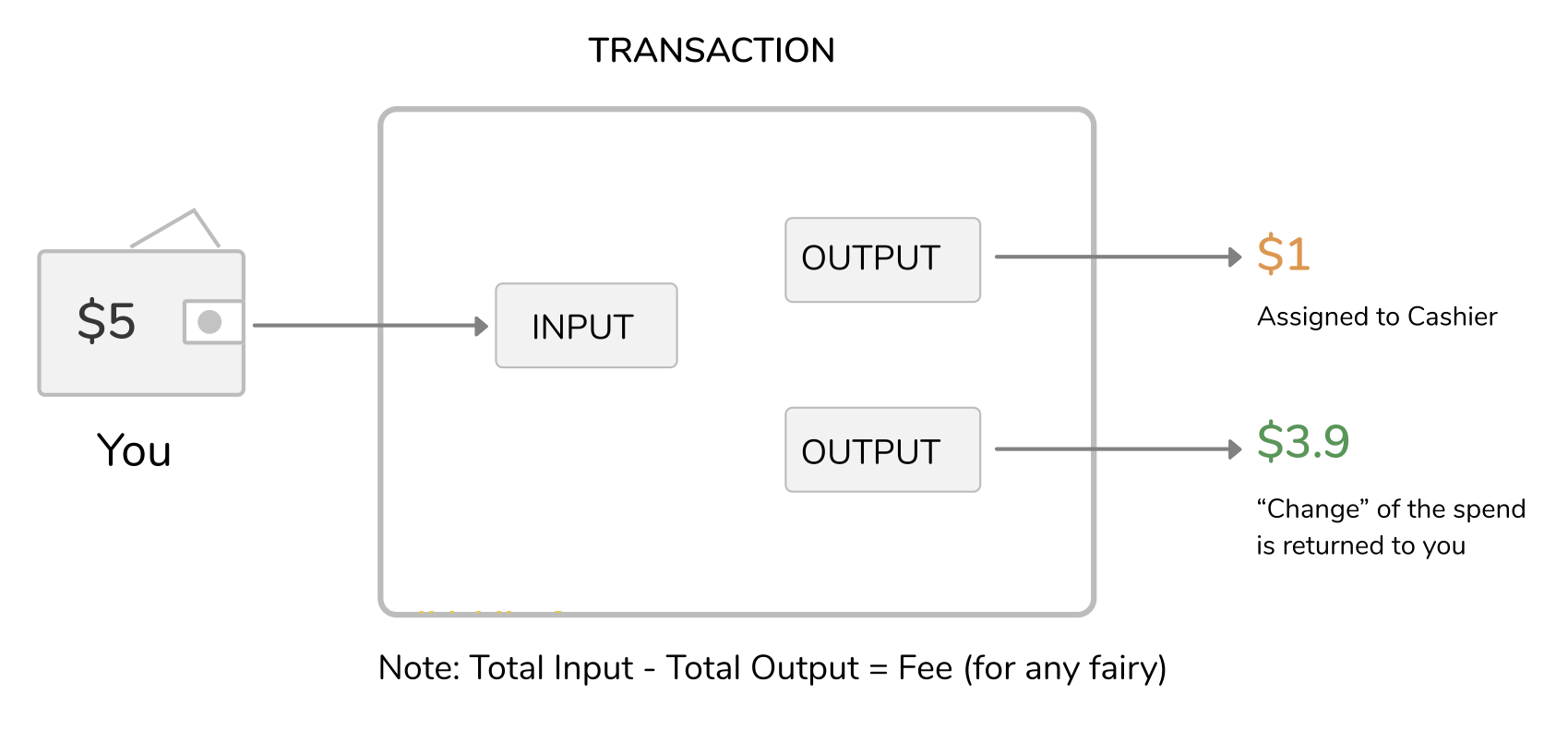
Simple Reality About UTXO
Each UTXO is like a single coin or a piece of paper money. If you have 45 dollars in cash, you must have more than one bill because there’s no such thing as a forty-five dollar bill in reality. When you have 45 dollars in your wallet, you can have any combination of bills - UTXOs - that are in your wallet.
In this simple example, you could have any of the following combinations of cash:
- Forty-five one-dollar bills
- Nine five-dollar bills
- Four ten-dollar bills and one five-dollar bill
- Two twenty-dollar bills and five one-dollar bills
- Etc.
There are many combinations of bills that total 45 dollars. In each case, you have exactly 45 dollars even though you actually have different numbers of bills in each scenario.
The same is true with UTXO. Although you see a single balance when you log into your cryptocurrency (digital currency) wallet, you may have one or multiple UTXOs existing in your wallet. These UTXOs are different sizes but when added together, the total equals your wallet’s total balance.
When you buy an item with cash, you may not be able to provide the exact amount needed to pay for it. Let’s say you buy a cup of coffee for $3.50. You have 45 dollars in your wallet, but chances are you don’t have exactly $3.50 to pay for the coffee. Instead, you need to pay with more than one (or a few) bills and then receive some change back. You could pay for the coffee with four one-dollar bills, in which case you would receive two 25-cent coins back. Or you could pay for the coffee with a 20-dollar bill, in which case you would get back one ten-dollar bill, one five-dollar bill, one one-dollar bill, and two 25-cent coins. Now I’m sure you’ve gotten the idea somewhat.
The same thing happens when you send cryptocurrency (digital currency). Suppose you have a total of 740 LTC. Imagine that your balance is in the form of 3 UTXOs: with corresponding amounts of 320 LTC, one second is 215 LTC, and one third is 205 LTC.
If you want to send a smaller amount of LTC to another address, your wallet must send at least one UTXO to complete the transaction. Just like you can’t pay for a $5 item by tearing a $10 bill in half and handing the cashier one half, you can’t send half a UTXO to complete a cryptocurrency (digital currency) transaction. You must send the entire UTXO and then receive change back.
Imagine you want to send 30 LTC to a friend. You would need to send one of your UTXOs (10, 20, or 50 LTC) to complete the transaction. Your friend will receive a single UTXO of 30 LTC. You will receive a new, smaller UTXO with 290, 185, or 175 LTC, depending on which UTXO was sent.
What happens if you want to send your friend 350 LTC? Basically the same thing will happen, except this time you will need to send two full UTXOs to complete the transaction. Your friend will still receive their 350 dollars LTC and you will receive a new UTXO back (70, 175, or 185 LTC, depending on which two UTXOs were sent to make the payment).
The Difference Between Bills and UTXO
The real-world example above is accurate enough to provide you with a solid understanding of the UTXO concept, but it’s not perfect. Reality differs from blockchain in several ways.
First, the examples above are not accurate because you will need to pay a transaction fee to make your transaction. When you send a certain amount of money to another address, the new UTXO you receive will be the original UTXO amount minus both the amount you sent and the blockchain transaction fee you must pay.
New UTXO = (Total Original UTXO) - (Total Amount Sent to Another Address) - (Transaction Fee for That Specific Blockchain)
Transaction fees vary from blockchain to blockchain and can even change on the same blockchain at different times.
Second, the real-world example is not like UTXO in that cash bills are fixed in denomination value. In other words, paper money is limited to the value that the government chooses to print.
In the United States, bill denominations that exist are: $1, $5, $10, $20, $50, and $100. In countries using Euro, bill denominations are: €5, €10, €20, €50, €100, €200, and €500. These denominations don’t mention coins but what’s meant here is: you can’t create paper money with any amount you want. The value of each bill is predetermined.
This is not true with UTXO. A UTXO can be any amount. In fact, this brings some important benefits. That is, it creates much more flexibility than cash. You could have 1 million LTC in a single UTXO, rather than thousands of bills with each different denomination.
Blockchain programmers have the opportunity to write code to optimize how small denominations of cryptocurrency are packed into “paper” UTXOs. This means programmers can work together to keep the data capacity of the blockchain manageable. The better a digital wallet programmer is, the more efficiently new UTXO denominations will be created. Creating more efficient UTXOs means minimal data capacity and optimized processing speed. However, blockchain technology has a limitation when compared to cash: the number and quantity of UTXOs in each digital wallet must be recorded. Because of the result of most blockchain protocols, requiring all transactions to occur on a public ledger, the only time UTXOs can be assembled or divided into larger or smaller sizes is when you engage in a transaction on the public blockchain. If you don’t send or receive money, the number and total of UTXOs you hold in your wallet cannot be adjusted.
In practice, this is only a minor disadvantage. The number and size of UTXO in your wallet will naturally change over time. You may have many smaller UTXOs that make up your full balance, or sometimes you may have one large UTXO that includes all your account balance.
From an end-user perspective, it’s usually not necessary to understand the UTXO concept. The balance you see in your digital currency wallet is the amount of money you have, regardless of the number and value of UTXOs that make up that amount.
This might make you wonder: why is UTXO important? A great question! The next section will explain.
Why is UTXO Important?
The idea of UTXO is very important for understanding two of today’s most important technologies: UTXO-based smart contracts and atomic swaps.
First, developers have figured out how to develop UTXO-based smart contracts. This is a major breakthrough because it makes Bitcoin protocol coins capable of supporting Turing-complete smart contracts and decentralized applications. These UTXO-based smart contracts are language-independent and allow each UTXO to have a unique consensus mechanism. It is truly a revolutionary development.
Second, UTXO is crucial for decentralized exchanges based on atomic swaps.
For those who may not be familiar, an atomic swap is a peer-to-peer cryptocurrency transaction that requires no intermediary or third party. There is no escrow service, proxy code, or other centralized account. Instead, atomic swap is a direct cryptocurrency transaction between the wallets of users, from blockchain to blockchain.
It is important to understand UTXO before understanding how atomic swaps work because users must have at least 2 UTXOs each time to complete an atomic swap exchange.
According to: komodoplatform